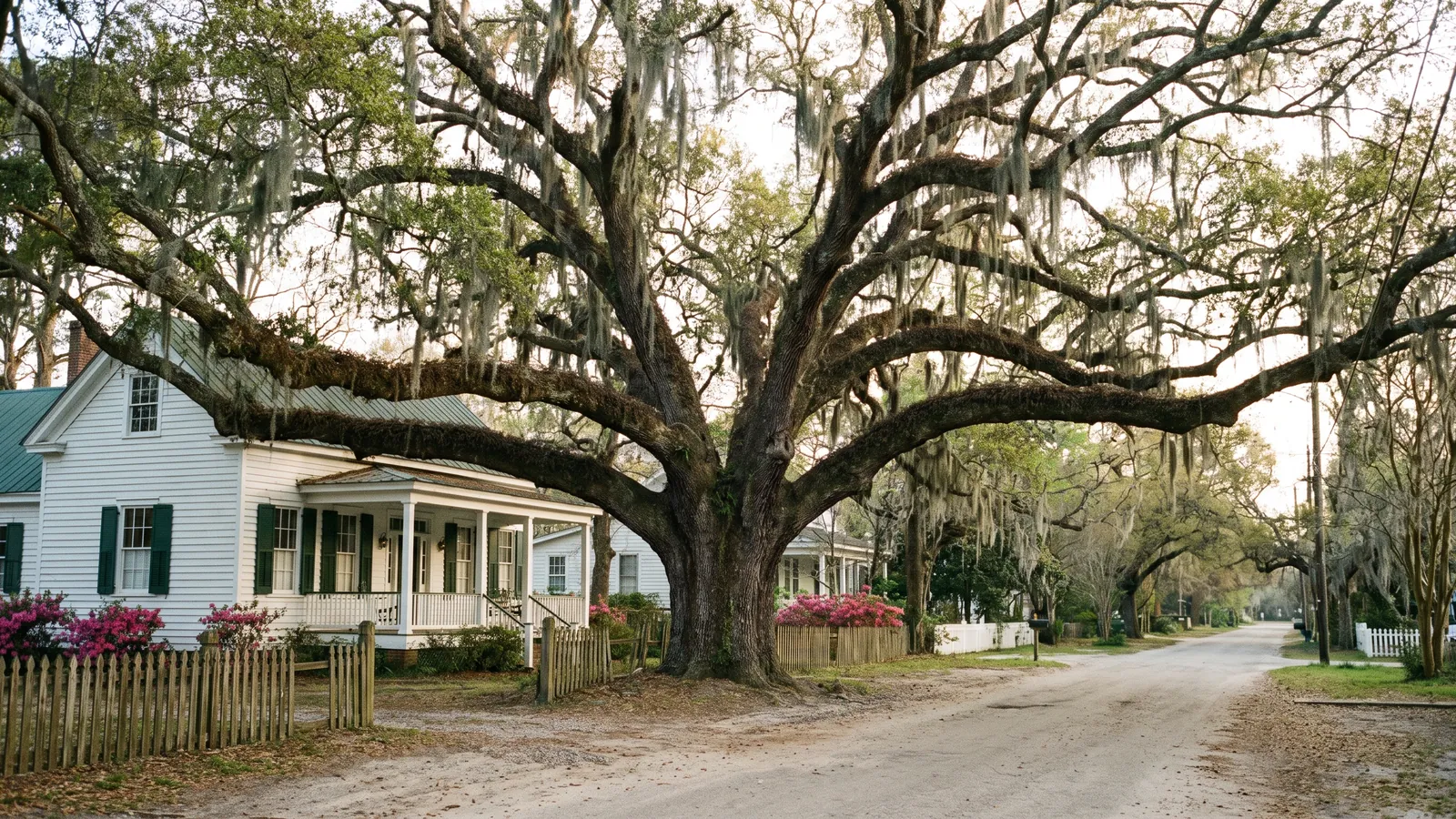
Why the live oak is the tree to keep
The live oak (Quercus virginiana) is evergreen — the name means it's 'alive' in winter when the other oaks are bare — and it's built differently from every other oak on the Strand. Its wood is dense and heavy, its limbs spread low and wide instead of reaching up, its roots go wide and deep, and it tolerates salt spray that kills most hardwoods. In the University of Florida's rankings of wind resistance, which are the ones arborists use across the Southeast, live oak and sand live oak are at the very top with sabal palmetto, magnolia, bald cypress and crape myrtle; through Hurricanes Erin, Opal and Ivan, live oaks survived at 96, 95 and 91 percent. It also lives for centuries. The allée at Brookgreen Gardens was planted in the 1700s and the trees are 250 to 300 years old. Conway's named oaks were there before the railroad. A big live oak in your yard is the single most valuable landscape feature on the Strand, and the towns treat it that way.
Live oak, laurel oak or water oak?
This is the question that decides everything, and the three look alike when young. Live oak leaves are thick, leathery, dark green on top and gray-green below, oval with edges that curl under, and the tree keeps them all winter, dropping the old ones in spring as the new flush comes. Laurel oak (Q. laurifolia) leaves are thinner, longer and more pointed, and the tree drops them over the winter; water oak (Q. nigra) leaves are spatula-shaped, wider at the tip. Live oak bark is deeply furrowed and blocky; laurel and water oak bark is smoother and grayer. The form: live oaks spread wide and low, laurel and water oaks go up. The lifespan: live oaks for centuries, laurel oaks 50 to 70 years before they hollow, water oaks 30 to 50 before their trunks rot. The wind rankings: live oak at the top, laurel and water oak at the bottom. And the rules: in Myrtle Beach a live oak is a significant tree from four inches and a landmark at 25, while a laurel oak is unregulated until it's a 30-inch landmark; in Horry County the specimen rule is live oaks only. Send us a photo of the leaves and the bark and we'll tell you which you have.
What landmark and specimen status mean
Every jurisdiction on the Strand singles out the big live oaks. Myrtle Beach calls a live oak 25 inches in diameter at breast height a landmark — removable only if a certified arborist documents it as hazardous, diseased or declining, or by a BZA special exception, with a $10,000 penalty per tree otherwise, and the owner and the tree cutter both liable. Horry County calls every live oak 24 inches and up a specimen, on house lots included, with ZBA variances for removal and a two-year building-permit block for violations. Conway's Tree Board decides on every live oak 24 inches and up and every tree on the Oaks of Conway map, and even pruning one requires a (free) permit. Surfside Beach calls a 24-inch live oak a landmark. Georgetown County protects every tree over 10 inches on the Waccamaw Neck; the Town of Pawleys Island protects hardwoods from five. In practice: measure before anyone touches it, and expect that a healthy big live oak will be pruned, not removed.
Caring for one
A mature live oak needs less than people think and more than it usually gets. Every three to five years: deadwooding (the dead limbs come down on your schedule instead of a storm's), crown cleaning (crossing and rubbing limbs removed), and weight reduction on the long horizontal limbs over the house — shortened back to a lateral branch, never stubbed. All of it to the ANSI A300 standard: cuts at the branch collar, never flush, never more than a quarter of the live crown in a year. Never topping — it rots the stubs, pushes weak sprouts, and in Myrtle Beach it's legally a removal. Never lion-tailing (stripping the interior and leaving tufts at the tips), which loads the limb ends for failure. Protect the root zone: the critical roots extend well past the drip line, and the driveway, the pool, the addition or the utility trench that cuts them is how a 200-year-old tree dies in five years. Leave the Spanish moss and the resurrection fern alone — they're epiphytes and take nothing from the tree. And don't fertilize a healthy live oak; it doesn't need it.
When a live oak really has to come down
Sometimes. A live oak that's been topped repeatedly, a trunk that's hollow through most of its cross-section, a major limb failure that's opened the tree to decay, a lean that's new after a storm with the root plate heaved, construction that's cut the roots on two sides — these are the cases where our arborist's assessment, to the ISA tree risk standard, documents a hazard the towns will accept. A live oak with a hollow but a sound shell, a lean it's had for fifty years, or some dead limbs is not one of them, and no honest letter will say it is. When a removal is justified, it's a permitted job: the arborist report, the application, the mitigation, the Tree Board or ZBA if required, and then a crane, because a big live oak is always over something.
Common questions
Is my live oak too close to the house?
Probably not. Live oaks spread wide and the limbs over the roof can be reduced; the roots rarely damage a foundation. The towns allow removal within 10 feet of the footprint in some cases, but a reduction is usually the better answer.
Can I remove the Spanish moss?
You can, but you don't need to — it's harmless. We remove it only where a heavy load is adding weight to a limb that's already weak.
My live oak dropped a big limb. Is it failing?
Live oaks shed limbs occasionally, especially long horizontal ones in wet weather ('summer branch drop'). One limb isn't a verdict; a pattern, decay at the break, or a hollow sound at the base is. We'll look.
Do I need a permit to prune my own live oak?
In Conway, if it's a landmark, yes. Elsewhere, pruning to the standard is fine; topping is not. Over the roof or over a few inches, have it done properly.
Related: Live oak care · Permits town by town · Tree trimming · Trees that fail in hurricanes